Guide
A complete guide to alloy and steel wheels
Alloy and Steel Wheels – The Complete Guide to Choosing Car Rims [2026]
1. Introduction
Introduction to car rims
Choosing rims isn't just about how your car looks — it's also about technical fit, durability, and everyday comfort. Well-chosen rims need to match your car's parameters, work properly with the right tyres, and keep correct values for things like ET (offset), bolt pattern, or center bore.
Alloy wheels also improve a car's appearance and, thanks to lower unsprung mass and reduced load on suspension components, can help reduce fuel consumption. They also affect ride comfort and driving safety.
Why choosing rims matters
In practice, drivers most often wonder whether steel or alloy wheels are better, what size to choose, and whether bigger rims really improve the look and handling of a car. These are reasonable questions, since rims affect the practical, visual, and cost side of things all at once.
Do rims affect safety and handling
Yes, but not because one type is inherently safe and the other unsafe. What matters most is a correct fit for the car, matching technical parameters, and the build quality and condition of the wheel. Weight, load rating, damage resistance, and behaviour after hitting a pothole all matter. Steel rims tend to bend rather than crack, while alloy wheels tend to be lighter and can improve the car's steering response and braking performance.
Who this guide is for
This guide is for drivers who want to make an informed choice of rims and understand what to look at beyond just the looks. It's useful both for people buying their first set of rims and for those planning a size change, a used-wheel purchase, or a winter wheel set.
2. What car rims are
Basics, construction, and manufacturing of rims
What a rim is
A rim is the metal ring of a wheel that holds the tyre and mounts onto the vehicle's hub. It's one of the basic parts of the running gear, since it connects the tyre to the car and has to carry the loads generated while driving, braking, and cornering.
Rim construction
- Bead flange – the outer part of the rim that interfaces with the tyre.
- Barrel – the main part of the rim, on which the tyre bead sits.
- Hub / center section – the area where the rim mounts to the car.
- Center bore – the hole matched to the hub, or paired with a hub centric ring.
- Bolt holes – positions for the bolts or nuts, matching the bolt pattern.
How rims are manufactured
Steel rims are usually made from stamped and welded steel, which means a simpler construction and lower production cost. That's one reason they're usually cheaper than alloy wheels. Alloy wheels are made using other methods — cast, forged, or produced with flow forming technology — which lets them have more complex designs and often a lower weight.
3. Types of rims
The most important types of car rims
Steel rims
Associated mainly with practicality, simple construction, and a lower purchase price. Often chosen by drivers looking for an economical solution for daily driving, fleet cars, or winter use.
- Pros – lower cost, good impact resistance, can be straightened.
- Cons – heavier, plainer looks, prone to corrosion once the coating is damaged.
- When worth buying – when budget and use in harsh conditions are the priority.
Alloy wheels
Popular mainly for their looks, wider choice of designs, and often lower weight than steel equivalents.
- Pros – more attractive design, wider model choice, better weight.
- Cons – higher purchase price, some models more sensitive to hard impacts.
- When worth buying – when looks and a lighter wheel set matter to you.
Forged, flow-formed, and magnesium rims
Forged rims are a premium solution, used mainly in sports cars and tuning projects, where a very favourable strength-to-weight ratio matters. Flow-formed models sit between a classic cast wheel and more advanced technologies, while magnesium rims remain a niche product found mainly in motorsport.
Avoid cheap, low-quality rims
Rims made from lower-grade alloys can shatter on hitting a kerb. Although they may look nice and be cheap, they fall short of proven, branded equivalents in quality — worth keeping in mind especially at very low prices.
4. Alloy or steel rims
A detailed comparison of the two most popular solutions
In terms of price, steel rims are usually the more affordable option, which is why they're often chosen as a second wheel set, especially for winter. Alloy wheels are generally more expensive, but offer a wider choice of designs, finishes, and manufacturing technologies.
In everyday use, steel rims handle pothole impacts well and tend to bend rather than crack. Alloy wheels are usually lighter, more visually striking, and can dissipate heat from the brakes more effectively, which benefits their durability.
| Criterion | Steel rims | Alloy wheels |
|---|---|---|
| Price | Usually cheaper to buy. | Usually more expensive, but a wider choice of models. |
| Strength | Bend more easily and can be straightened. | Stiffer, but can crack on a hard impact. |
| Weight | Usually heavier. | Often lighter, which can improve the car's response. |
| Corrosion | Prone to rust once the coating is damaged. | Modern models have protective coatings. |
| Winter use | A popular, practical budget choice. | Work well too, if good quality and well maintained. |
Quick recommendation
If price and practicality in winter matter most to you, steel rims are a sensible choice. If looks, a wider choice of designs, and potentially lower weight matter more, alloy wheels are the better fit.
5. How to choose rims for your car
Data you need to check before buying
It's always worth starting your rim selection by checking your car's basic data. Make and model alone aren't enough, since even within one model, different engine versions, model years, and trim levels can have different wheel parameters.
- Check the bolt pattern of your car (use our bolt pattern table) — look up your car's model, year, and engine, and note the bolt pattern so you only buy rims matching that exact spec.
- Choose the right width and diameter. Don't go overboard compared to the factory size — if you have 6Jx15" rims, don't jump straight to 8Jx18". Pick a size close to factory, e.g. 6.5Jx16" or 6.5Jx15".
- Choose the right offset (ET) — ideally the same as, or close to, the factory value.
- Pay attention to the center bore diameter — manufacturers often make rims with a larger bore that takes a hub centric ring.
How to use the VIN when choosing rims
The VIN is one of the most reliable sources of information about your car's exact configuration. It lets you pin down the vehicle's exact version, and in turn check what wheel sizes and parameters the manufacturer specified.
Where to find manufacturer data
The key technical data about rims can be found in the vehicle's owner's manual, on the VIN plate, in the manufacturer's catalogue, on the currently fitted rims, or in our bolt pattern table.
A practical example
For example, a 1998 Opel Astra G has a 4x100 mm bolt pattern. If this car has 15-inch rims fitted, you could consider 16- or 17-inch ones, within reason — a larger rim diameter needs a lower-profile tyre to keep the wheel's overall diameter the same, which lowers ride comfort and increases load on the suspension and wheel bearings.
The car manufacturer usually gives an accepted ET range, e.g. 33-38. An ET that differs from the recommended value can affect how the car behaves in corners.
6. Rim parameters and markings
ET, bolt pattern, center bore, width, and diameter
Alloy wheel cross-section
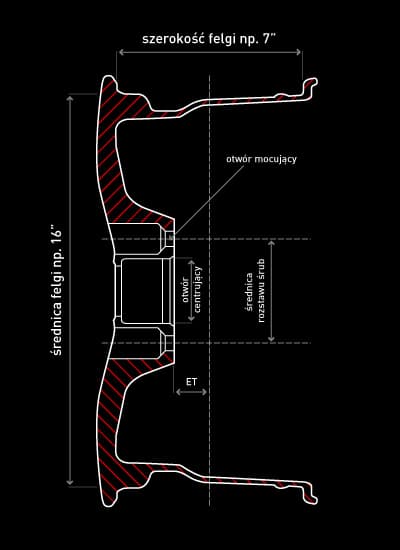
Bolt pattern (PCD)
These parameters define the number of holes and the bolt circle diameter on the rim. Example: 5x100 — 5 is the number of holes, 100 is the diameter of the circle [mm] on which the wheel-mounting bolts sit.
Center bore
The center bore, also called the hub bore, must match the hub flange exactly. Hub centric (reducer) rings are used to allow a given rim type to fit different cars.
Offset (ET)
The distance between the rim's symmetry plane and the plane where the wheel contacts the car's mounting surface. It can be negative or positive. A high ET, e.g. 45, tucks the rim deep into the wheel arch. A low ET, e.g. 15, pushes the rim further outward.
Rim width
The inner distance between the rim's two flanges. Rim width is what defines the size of the wheel.
Flange
Under high lateral forces (e.g. while cornering), the bead hump on the rim keeps the tyre from sliding off the wheel, preventing sudden loss of tyre pressure.
Rim load rating
Defines the maximum load a given wheel can safely carry. It should never be lower than what the vehicle requires.
Bolt and nut type
There are different types of bolt seats — conical, spherical (ball), and flat. Always check whether your current fastening set fits the new rims.
Rim markings
Example: 6Jx15H2 ET28 — 6 is the size in inches, J is the flange profile, 15 is the diameter in inches, H2 is the rim's cross-section profile.
Example of a full marking
8Jx18 ET35 5x112 CB66.6
8J means the rim width and flange profile, 18 is the diameter, ET35 is the offset, 5x112 is the bolt pattern, and CB66.6 is the center bore diameter.
7. How to measure a rim
Instructions for measuring the key parameters
Rim diameter and width are measured at the tyre seating points, not along the outer edges of the wheel. ET is best read from the manufacturer's marking on the rim, while the bolt pattern is measured differently depending on the number of mounting holes — 5-bolt rims require particular care.
The center bore diameter is best checked with calipers on a clean rim. The most common mistakes are confusing bolt pattern with ET, measuring along the flange, and relying solely on the seller's description.
8. How to choose rim size
Sizes from 12 to 23 inches and their effect on the car
Changing the factory rim size is possible, but you need to keep the overall wheel diameter roughly the same by choosing the right tyre profile. Smaller rims usually offer a lower cost and more comfort, while larger ones more often improve the car's looks and can give a more direct driving feel. Bigger rims aren't inherently better, though — it's a choice that comes with a trade-off between looks, comfort, tyre cost, and resistance to bumps.
Matching rim diameter to rim width
| Rim width [inches] | Rim diameter for sporty driving | Rim diameter for normal driving | Rim diameter for off-road driving |
|---|---|---|---|
| 4J | - | 12, 13 | - |
| 4,5J | - | 13, 14 | - |
| 5J | 14, 15 | 13, 14 | - |
| 5,5J | 14, 15 | 13, 14 | - |
| 6J | 15 | 14 | 15 (SUV), 16 |
| 6,5J | 15, 16 | 14 | 16 |
| 7J | 16, 17 | 15 | 16, 17 |
| 7,5J | 17 | - | 17 |
| 8J | 17, 18, 19 | - | 18 (SUV), 19 (SUV) |
| 8,5J | 17, 18, 19 | - | - |
| 9J | 18, 19, 20 | - | 19 (SUV) |
| 9,5J | 19, 20, 21 | - | - |
| 10J | 20, 21, 22, 23 | - | - |
9. How rims affect the car
Comfort, fuel use, grip, and handling
Rims affect the car mainly through their weight, diameter, width, and their combination with the right tyre. Lighter wheels can improve the feeling of dynamics, and larger rims with a lower-profile tyre usually boost the visual effect, but can reduce ride comfort and increase noise.
A poorly chosen ET, too much wheel weight, or an incorrect overall wheel diameter can affect handling, suspension wear, speedometer readings, and the operation of systems like ABS and ESP.
10. Fun facts
Did you know...?
- An alloy rim is noticeably stiffer under lateral loads (in corners), due to a different cross-sectional design.
- An alloy rim allows for better ventilation and direct cooling of the brakes thanks to its open, spoked construction, which affects brake performance and durability.
- An alloy rim dissipates heat from a hot brake disc through the wheel hub more effectively, which affects the performance and durability of the brakes (discs, drums, pads, shoes).
- An alloy rim withstands dynamic driving better (it doesn't crack from material fatigue near the hub mounting).
- An alloy rim holds the tyre bead on the rim better, reducing the risk of pressure loss under heavy loads.
- An alloy rim allows for better balancing thanks to the ability to permanently attach wheel weights anywhere on it.
- An alloy rim isn't always lighter than its steel equivalent.
- "Good" alloy rims are more resistant to weather and chemical exposure (e.g. road salt in winter).
- "Good" alloy rims don't corrode, so they keep their good looks for many years.
- Alloy rims are considered more prestigious and better-looking.
- Alloy rims are more expensive than steel ones.
- Alloy rims need more frequent care, e.g. washing to remove brake dust.
- Alloy rims can be straightened, but it's not recommended, since it can weaken the rim and increase the risk of cracking.
- You can't fit hubcaps on alloy rims.
- Damaged alloy rims from budget manufacturers can be refurbished, as long as they aren't deformed.
11. How to choose tyres for your rims
What tyres can I fit on my rims?
Choosing a tyre for a rim starts with a matching diameter and the right width. The tyre has to fit the rim's diameter, and its width should fall within the allowed range for that particular rim. The safest rule is simple: choose the diameter first, then check the width range, and finally make sure the whole wheel keeps a diameter close to the original.
| Rim width [inches] | Tyre width for sporty driving | Tyre width for normal driving | Tyre width for off-road driving |
|---|---|---|---|
| 4J | 135, 145 | 135, 145 | - |
| 4,5J | 145, 155 | 165 | - |
| 5J | 165, 175 | 185 | - |
| 5,5J | 175, 185 | 195 | - |
| 6J | 185, 195 | 205 | 205, 215 (SUV), 225, 235 |
| 6,5J | 205 | 215 | 235, 245 |
| 7J | 215 | 225 | 245, 265 |
| 7,5J | 225, 235 | - | 235, 255 (SUV), 265, 275 |
| 8J | 225, 235 | - | 255 (SUV) |
| 8,5J | 245, 255 | - | - |
| 9J | 255, 275 | - | 275, 285 (SUV) |
| 9,5J | 285, 295 | - | - |
| 10J | 305, 325 | - | - |
12. Rims for winter and summer
Which solution works better for each season
In winter, many drivers choose steel rims as a practical, cheaper second wheel set. At the same time, modern alloy wheels are also suitable for winter, provided they're good quality, have a proper protective coating, and are washed regularly.
In summer, alloy wheels are chosen more often for their looks, wider choice of designs, and lower weight. Regardless of the season, matching the parameters correctly and proper care remain key.
13. Most common buying mistakes
Mistakes that most often cause fitting problems
The most common mistakes include the wrong bolt pattern, incorrect ET, too-wide a rim, choosing the wrong bolts or nuts, and missing hub centric rings. Some drivers also overlook load rating and homologation, focusing solely on the rim's looks.
The biggest mistake is buying a wheel based purely on design or price. With rims, looks should be the last step of the decision, not the first.
14. Hub centric rings
How to deal with different bore diameters
Hub centric rings are meant to match a rim's center bore to the car's hub when the rim's bore diameter is larger than the hub's diameter. They're usually plastic, but can also be made of aluminium or other alloys.
Using these rings keeps the wheel stable, without play. Without them, the wheel relies solely on the bolts, which can be very dangerous if one breaks (the wheel can start to vibrate).
The inner diameter of a rim's center bore is given in millimetres, e.g. 73.1 mm — meaning the hole in the rim's central section has exactly that dimension. This allows the rim to be precisely seated and centered on the hub. When there's a mismatch between the center bore size and the hub diameter, hub centric rings are used to close that gap, and are usually supplied by alloy wheel manufacturers.
15. Use and maintenance
How to clean, maintain, and when to refurbish alloy wheels
Proper, regular cleaning of alloy wheels keeps their looks and physical properties intact for a long time. During use, their surface picks up grime from brake dust, road dirt, and salt, and the rims are also exposed to moisture and stone chips.
Typical grime is a mix of brake dust and road dirt. If alloy wheels go uncleaned for a long time, a grey-black deposit builds up that's very hard to remove and ultimately leads to corrosion. We recommend using high-quality alloy wheel cleaning products (waxes, foams, gels), since household cleaners or car shampoos won't remove this kind of grime.
A few important rules for proper alloy wheel care and cleaning:
- It's best to wash alloy wheels when cold; you can also wax them, but wash them thoroughly first.
- Try to avoid very strong acid-based detergents (as well as alcohols, petrol, or solvents), as they can damage or discolour the outer paint coating.
- When cleaning alloy wheels, try to use a sponge or cloth with running water. Using high-pressure washers can cause the paint coating to flake or peel off.
When to refurbish, and when to replace a rim
If you're planning to buy used rims, make sure they're straight — straightening is an extra cost, and it's worth checking a rim's condition at a tyre shop on a balancing machine. Refurbishing damaged rims can include powder coating, sandblasting, straightening, repainting, or CNC face turning. Before a repair, it's worth comparing the service cost with the price of buying another set in good condition.
16. Buying rims
New, used, OEM, or aftermarket
Buying used rims can make sense if you want to lower the cost, or buy an original set for less than a new one. However, you need to carefully check that the parameters match, along with runout, the condition of the flanges, cracks, manufacturer markings, and signs of previous repairs.
OEM rims usually give more predictable compatibility with the car, while the aftermarket offers a wider choice of designs and configurations. Whichever you choose, real technical condition, load rating, and homologation are what matter.
It's also worth being cautious of very cheap rims of unknown origin — made from lower-grade alloys, they can shatter on hitting a kerb. Although they look nice and are cheap, they fall short of proven, branded equivalents in quality.
17. Homologation and certification
ECE, TÜV, JWL, and VIA
A rim's homologation confirms that a given model meets specific quality, strength, or approval standards. When buying, especially aftermarket and used rims, it's worth paying attention to markings stamped on the rim and documents confirming product compliance.
ECE, TÜV, JWL, and VIA are markings that increase a product's credibility and make it easier to verify a rim's origin. Certificates don't replace choosing the right parameters, but they're an important quality filter.
18. FAQ
Frequently asked questions from drivers
Do alloy wheels rust?
Alloy wheels don't rust the same way steel ones do, but their protective coating can get damaged, and the surface can oxidize and deteriorate. That's why alloy wheels also need regular washing and checks of the paint condition.
Are steel rims safer?
You can't say steel rims are inherently safer. Safety is determined by correct selection, build quality, technical condition, load rating, and matching the parameters to the car.
Can ET be different from factory?
Small deviations do occur, but ET shouldn't be changed at random. Every change needs to be assessed sensibly and in the context of the specific car, since it affects wheel position, clearance in the arch, and suspension behaviour.
What bolts should I buy for my rims?
Bolts or nuts have to match the seat type in the rim and the fastening system designed for the car. You need to check whether the rim requires a conical, spherical, or flat seat, and whether your current fastening set will still be suitable.
Does a bigger rim increase fuel consumption?
It can, but not always. If a bigger rim also means a heavier wheel, the car may need more energy to accelerate, especially in city driving. In practice, though, what matters is the whole package: rim weight, tyre, wheel diameter, and driving style.
Can rims be straightened?
Many rims can be straightened, especially if the issue is deformation rather than a serious crack. Every case should be assessed by a specialist, though, since not every repair will be safe and worthwhile.
What rims for winter?
For winter, you can choose either steel or alloy rims. If a lower cost and a simple second wheel set matter to you, steel is chosen more often. If you prefer better looks and a lighter set, good-quality alloy wheels can also work well in winter.
What rims for an SUV?
For SUVs, load rating, homologation, and matching the parameters to the vehicle's weight are especially important. With these cars, it's not worth going by looks alone, since a too-light or poorly chosen rim may not meet the technical requirements.
What rims for an electric car?
In electric cars, rim load rating, total wheel weight, and the set's effect on driving efficiency all matter a lot. EVs tend to be heavier than combustion cars, so rims for them need to be chosen especially carefully and in line with the manufacturer's recommendations.
19. Glossary
The most important abbreviations and terms
Offset, i.e. the rim's position relative to the hub.
The number of mounting holes and the diameter of the circle their centers sit on.
The diameter of the rim's center bore, matched to the hub with hub centric rings.
Original rims, supplied by the car's manufacturer.
20. Summary
The key rules for choosing rims
It's worth starting your rim choice not with the design, but with the technical parameters. What matters most is matching the bolt pattern, ET, center bore, diameter, width, and load rating, and fitting the rim to your specific car model. Only after confirming compatibility is it worth moving on to comparing steel and alloy rims in terms of price, looks, weight, and seasonal use.
Pre-purchase checklist
- Check the bolt pattern, ET, center bore, and size.
- Verify the load rating and homologation.
- Choose the right bolts or nuts.
- Compare new rims with used ones and assess their technical condition.
Sources used in this guide include: http://www.wojdas.24x7.pl/opony.html
How can we help you?
Get in touch
Need help with rims or fitment? Contact us for expert advice and solutions tailored to your needs!

© FelgiSportowe.pl | Design by Aurora Studio: aurorastudio.eu
Keywords: Alloy wheels, Wheel size, Wheel offset, Wheel center bore, Wheel bolts, Alloy wheel fitting, Wheel bolt pattern, Car rims, Sport rims, Off-road rims, Wheel replacement, Types of alloy wheels, Wheel lug bolts, Wheel refurbishment, Used rims for sale, Rim markings, Rim bore diameter, Custom rims, SUV rims, Passenger car rims, Standard driving rims, Off-road driving rims, Rim width, Rim profile, Types of wheel bolts, Truck rims, Rim change, Bolt pattern chart, Rims and tyres, Alloy wheels for sale